This is not a post to cause drama but to provide information. A Coup d'état was declared by members of the Malian military last night in Bamako, Mali's capital. For information or background on what transpired yesterday, check news coverage online (BBC, Reuters etc).
George and I are currently in a very safe location. We are not afraid for our safety and will continue to stay where we are until we receive further direction from our superiors who work closely with the US Embassy on security matters. As far as what may happen in the long term, resolution of the coup remains uncertain. Our lives as Peace Corps Volunteers could easily return to "normal" or on the opposite end of the spectrum, we could be sent home. I want to emphasize that we do not yet have confirmed news one way or the other. Most importantly, we are safe where we are. We will keep you all posted if we learn of any new developments.
Pray for peace.
Thursday, March 22, 2012

Monday, March 19, 2012
Guest Author: Michael Comes to Town
Travel Warnings Be Damned
First things first: George and Anna are great, remain in wonderful spirits and look healthy. If you’re worried about their well-being, stop - there’s not much need. They’ve adopted well, have meaningful friendships, and know how to navigate daily life very well here.
Now for my actual post:
“Mali Mali Mali
I came into this trip with few expectations. Don’t misunderstand that as low expectations. I was very excited to see George and Anna. I was curious to see how they lived and for them to show me around Mali
As my trip grew closer, a flurry of articles regarding the ongoing Touraeg rebellion in Northern Mali worried me. George and Anna assured me I would be safe. Plus, I don’t believe the Peace Corps would put their volunteers in harm’s way. My worries proved completely unfounded. The travel warnings issued by various countries seem almost silly compared to the situation on the ground in Southern Mali .
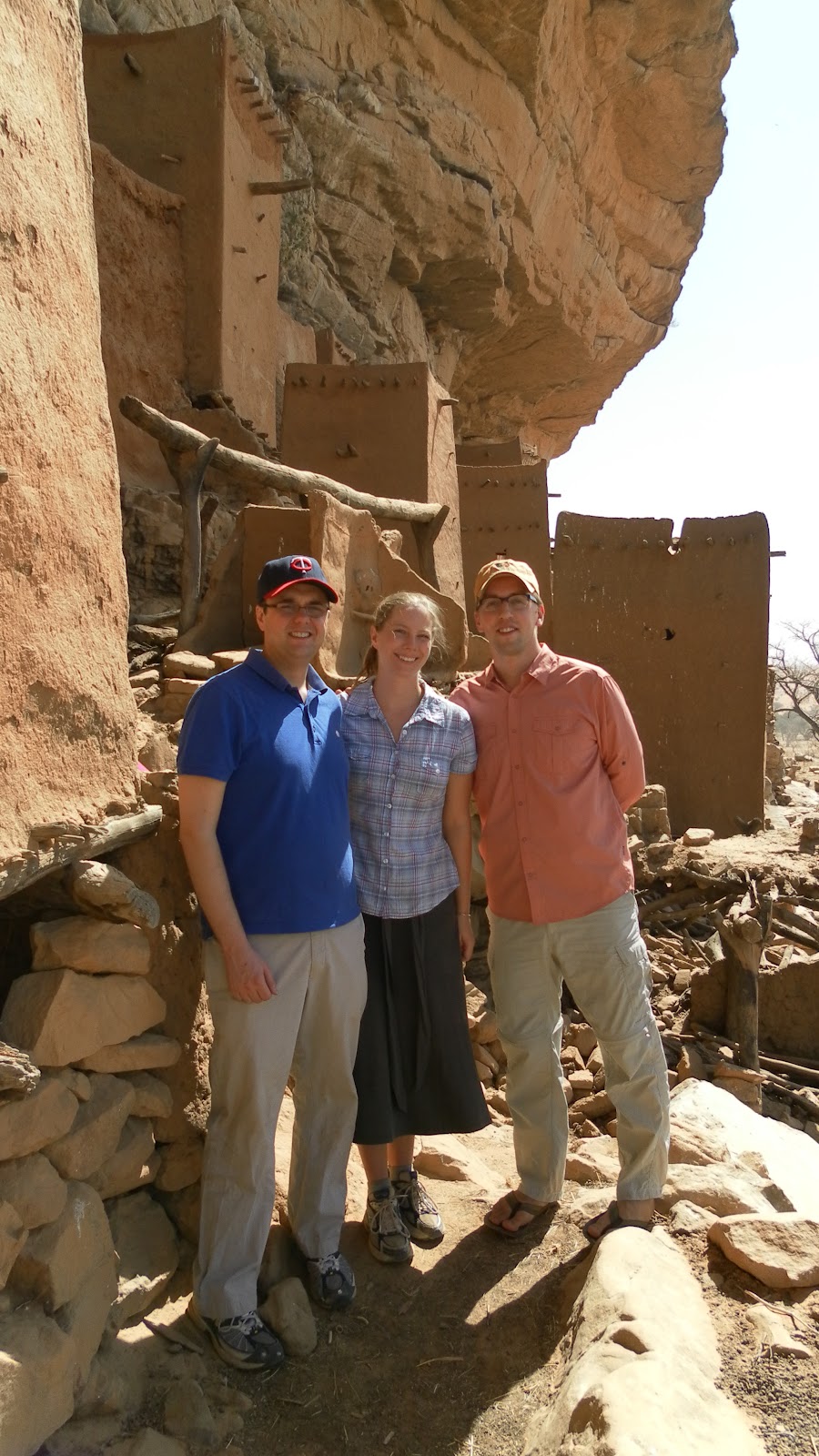
A short blog post can’t adequately describe the thoughts and emotions I’ve experienced here. I’m incredibly grateful for George and Anna for showing me around this astounding country. Though Dogon Country was an unbelievable experience, I am most grateful for the visit to their village in the Segou Region. George and Anna’s friends and neighbors in the village are so incredibly generous, even though they are quite poor by American standards. I wonder if I will ever experience the generosity offered by the villagers ever again. It’s unlikely I will, but I hope to replicate it throughout the rest of my life. Also, I am still astounded by how happy the villagers seem (and most likely, are), despite conditions that seem insurmountable by most Americans. Malians are a resilient people and know how to make the best of the many obstacles that pop up daily.
This has been an incredible trip. It’s renewed my appreciation for the US US
Day Hike in Dogon Country




Segou at Sunset


Village


Monday, February 20, 2012
Le Festival sur le Niger
.jpg)
The main stage sur le Niger
Confession - this photo was taken at the festival last year and I pulled it off of Google Images. Same look this year.
The biggest music festival of the year in Mali wrapped up yesterday in our very own regional capital, Segou. We spent 4 nights in a row listening to musicans on the banks of the Niger River and catching up with friends who came to town for the show. This year has been a particularly tough year for tourism in Mali, so it was fun to see Segou come alive with people, food stands, outdoor patios, dancing, and a pop up market. The festival draws primarily a Malian crowd and pockets of toubab festival junkie tourists. Unbeatable people watching.
Before coming to Mali people would always tell us that Malian music is world renowned. While I knew next to nothing about Malian music, the festival was a way for us to see all of the big names at once. Our personal best in show award goes to:
Kar Kar
Baba Sissoko
Pape Diouf (of Senegal)
Habib Koite
Sauti Soul (of Kenya)
Nafi Diabate
Cheik Tidiane Seck
Salif Keita
I am sure you can find some of these musicans on You Tube...if we tried to find videos for you the internet files would still be loading by the time the festival gets underway in 2013. For more info - festivalsegou.org
Naturally at a music festival in West Africa, we ran into a St. Olaf connection. Prior to coming to Mali, we learned about Cherif Keita, a professor from Carleton College who brings students here on a study abroad trimester every other year. Cherif's daughter also happens to work in Admissions at St. Olaf. At a late night performace we ran into Cherif's brother-in-law Oumar who runs a hotel in Segou. Oumar invited us to lunch the next day to meet Cherif, a wealth of knowledge on Mande history and culture and a friendly face who also allowed us to reminice about Northfield. Small world. Cherif has recently published an English version of his book on childhood friend Salif Keita (Outcast to Ambassador: The Musical Odyssey of Salif Keita). Salif Keita is THE most accomplished living musican in Mali and he brought down the house at the festival on Saturday night.
Thanks to our gracious host in Segou, we washed our clothes in a washing maching for the first time in over a year. What a treat. No need for a dryer though, clothes dry in no time when it is 100 degrees outside. I guess "cold season" is over.
Sunday, February 5, 2012
The World Map Project - A Peace Corps Classic
.jpg)
When we are not at our "jobs" (Anna at one of four weekly women's savings group meetings and I at our local health clinic), drinking tea with the neighbors, hauling water from the pump down the street, or at our host family's house hanging out, we try to keep busy with other small projects. One such small project was painting a world map. One time-honored Peace Corps tradition is to paint a world map in a local public space or school. After getting permission from the school director, we were given the wall space in the sixth grade classroom to paint ours.
Why a world map? Other than the fact that we like maps and it was a good way to keep busy for quite a few weekends, it creates a simple educational tool that will stick around in our community for a handful of years. Education in our town is quite robust compared to nearby villages and towns, but is nothing like what we have in the States. Most classrooms are spartan cement buildings. This particular sixth grade classroom holds 74 students, 1 teacher. Students copy all subject matter by hand from the blackboard into a notebook. Textbooks and other materials are almost non-existant. Couple that with most peoples' lack of travel, and you get a limited geography knowledge. For example, I am frequently asked questions like, "how long is the bus ride to America?" or when gone for a long weekend, "how was your trip home to America?" and even more frequently villagers confuse the United States and France as the same place.
We spent quite a few weekends working on our map. Like most things here, it ended up taking longer and being harder than planned. I have to admit that I thought my geography was pretty good before this, and was a little surprised by how little I actually knew. Here is a quiz for you - Without looking, name the following: one island between the African and South American continents; which countries replaced the former Yugoslavia; where is Azerbaijan; what countries border El Salvador; and which US state is closest to Bermuda. If you got two of those right you know more than I did.

Saturday, January 28, 2012
.jpg)
Saturday, January 14, 2012
Jatigi
A friend (or acquaintance, or even someone you have never met) drops in on you on your day off while you are taking a cat nap on the couch. Another drops in just as you are setting food on the dinner table. Your neighbor's inlaws are in town visiting for the week.
Do you welcome that uninvited friend in on your day off and offer him or her a seat and a drink? Do you dish up an extra plate of dinner for the one who inconveniently stopped by during the dinner hour? Do you cook up a meal and deliver it to those strangers visiting your neighbor?
If you are Malian, the answer to all of the above question is: yes. Hosting is the way of life here, regardless of who shows up at your doorstep or when. The word for host is "jatigi" and we have been blessed with a number of families that have gone out of their was to make us feel welcomed, well fed, and well cared for in village.
We eat lunch and dinner with three different jatigi families, and spend most evenings chatting with a fourth jatigi - my work counterpart and neighbor, Capi, his wife Assiata and their one year old son Musa. Before coming to Peace Corps I expected to play an active role in saving the world, but never expected become close friends with Malian my own age.
While we still have a ways to go on saving the world, we have developed true friendships with our jatigis Capi and Assiata. We cooked American food for them (chili and bread - a huge hit), Capi and George play late afternoon lawn games, Assiata and I cooked "birthday cake" aka french toast a few weeks ago for Capi. Their house is our nighttime hang out, and a place where we are always welcome to drop in for a quick chat or cup of tea.
Naturally Capi and Assiata's house was the perfect place for a New Years Eve party. And party we did...Malian style. Chicken, fries, bread, sodas and music. Though we didn't have a champagne toast at midnight, it otherwise felt like being at a lively house party in the States. Late night jokes, impromptu dancing, we closed the party down just before 4am.
Wishing you all a happy 2012!


Do you welcome that uninvited friend in on your day off and offer him or her a seat and a drink? Do you dish up an extra plate of dinner for the one who inconveniently stopped by during the dinner hour? Do you cook up a meal and deliver it to those strangers visiting your neighbor?
If you are Malian, the answer to all of the above question is: yes. Hosting is the way of life here, regardless of who shows up at your doorstep or when. The word for host is "jatigi" and we have been blessed with a number of families that have gone out of their was to make us feel welcomed, well fed, and well cared for in village.
We eat lunch and dinner with three different jatigi families, and spend most evenings chatting with a fourth jatigi - my work counterpart and neighbor, Capi, his wife Assiata and their one year old son Musa. Before coming to Peace Corps I expected to play an active role in saving the world, but never expected become close friends with Malian my own age.
While we still have a ways to go on saving the world, we have developed true friendships with our jatigis Capi and Assiata. We cooked American food for them (chili and bread - a huge hit), Capi and George play late afternoon lawn games, Assiata and I cooked "birthday cake" aka french toast a few weeks ago for Capi. Their house is our nighttime hang out, and a place where we are always welcome to drop in for a quick chat or cup of tea.
Naturally Capi and Assiata's house was the perfect place for a New Years Eve party. And party we did...Malian style. Chicken, fries, bread, sodas and music. Though we didn't have a champagne toast at midnight, it otherwise felt like being at a lively house party in the States. Late night jokes, impromptu dancing, we closed the party down just before 4am.
Wishing you all a happy 2012!

Cheers! Ringing in 2012 at Capi's house

Oumar dancing

Salim & Capi

Assiata, Musa & Bintu
Tuesday, December 27, 2011
Fruit Taxonomy
Growing up in the Cunningham house, at the bottom of your Christmas stocking you would always find an apple, an orange, and an assortment of nuts. Anna and I got our stockings in the mail from my mother, and sure enough the nuts were at the bottom. The orange and apple probably wouldn't have made the trip, but not to worry they are sold on the street. The local variety of oranges are actually green on the outside; orange colored oranges are for sale but expensive because they are shipped here internationally as well as all apples. There are also a whole swath of new fruits that we have found, some great and others not so much. I thought maybe you might like to see a few pictures and names of those others that are unfamiliar to you.
The first is my personal favorite naturally because it tastes surprisingly like candy. This one grows on a vine out in the bush, nobody I know really cultivates it, they just go out and collect when they are in season. The outside is pretty ugly and inedible, and with a little pressure it pops right open revealing the fleshy seeds that are so good. I recommend sprinkling a little sugar on this one, as the sourness can be overwhelming.
Next we have the refreshing and bizarre moussa melon. This tastes exactly like a cross between a cuke and a cantalope. They are easy to grow here I realized when many of them appeared growing big healthy vines from the seeds I threw in the compost pile. According to people in village a former Malian president Moussa Traore found these on a trip to Morocco many years ago and brought them back to this country because he liked them so much.
When I used to see American hand soap or lotion that was "made with shea butter" I always wondered, "what IS that anyway?" This mystery was solved when some vendors boarded a bus I was taking here in Mali selling bags of little green fruit. Shea fruit are edible, and taste a little like a sweet avocado with a similar texture. There is not much fruit on the outsite, and inside is a big nut. Apparently if you crack that nut the kernel inside can be processed to extract oil which is where the butter comes in. This stuff is internationally known to work wonders for skin and hair. There are not many of these trees in our village, so we don't really see these much outside of traveling. This oil can also be used to make food which gives whatever you are eating an indescribable and I think foul taste, I found this out the hard way while visiting our buddy Rob's village where they use it to make everything.
The English word for this one actually is custard apple, look it up. In Bambara, soonsoon trees come in two varieties tubab and regular. The regular variety are found everywhere, I have never seen these trees produce any fruit although they have nice shade. The tubab (word for white person, sometimes used to refer to French people only) variety are more rare and smaller, but have these really great tasting fruit. Malians were really surprised that I had never seen these fruit because they said that we tubabs brought these trees to Mali. You cannot eat the outside, but like the Sourpatch Kids TM fruit a little pressure and these pop open. The flesh is soft, sweet, and tropical tasting. Below you can see a sapling of this tree that was planted in our yard (not the worlds' most fertile soil...). Unfortunately it will not produce fruit until year 3 which will find us back in the ol' US of A. On a side note, to the volunteer who lives in our house starting in 2013, please mail me a check for all of the delicious fruit that you will eat as a result of my planting and my daily water hauling.
These little guys look like cherries or crab apples, but have a taste that I think is entirely different. This is wildly popular fruit here, and relatively expensive here as they usually come from a grafted tree. Some of our friends, American and Malian, really like them and say they taste similar to an apple. I would agree with them on the apple part, but I am not the I LIKE THESE club, as I think they have a weird dirty sock/smelly cheese aftertaste.
This next one grows on a palm tree and has big fruits that look like squash. In order to eat it, you need to boil it for the better part of a day. I really like this one. It is stringy, and you chew it until the flavor is gone then spit out the stringy stuff. This one is also hard to explain and really sweet with a bitter aftertaste. Anna and many others really don't like it. The Malian nickname for this one in donkey chewing gum, because they also like it.
Last and least of all we have the rock hard, dry cat food fruit. These also grow on palm trees and ripen in bunches. Kids slingshot rocks at them to get them out of the tree if they don't drop. Kids gnaw on the fruit which are only edible in a little layer on the outside. I tried these twice and thought it tasted like cat food, I say this with confidence because of some childhood taste-testing with cat food done by my sister Liz and I.
This guy doesn't belong, but I am happy to report that my green pepper, jalapeno, cherry tomato, and basil plants are all producing. Our friend Miriam says they look like doll house vegetables, but hey at least they're there.
Merry Christmas from Mali. We are enjoying a week in Segou, including two nights at a hotel. A fellow volunteer down the road had her whole family visiting and we tagged along with them on Christmas day.
 |
| Sourpatch Kids TM fruit or zaban |
 |
| Sourpatch Kids TM fruit opened |
 |
| Cucumber/cantaloupe melon or moussa melon |
 |
| Cucumber/cantaloupe melon opened |
 |
| Shea fruit |
 |
| Shea fruit opened |
 |
| Shea fruit nut |
 |
| Custard apple or tubab soonsoon |
 |
| Custard apple opened |
 |
| Custard apple sapling in our yard |
 |
| Smelly feet cherries or ziziphus fruit |
 |
| Smelly feet cherry inside view |
 |
| Donkey chewing gum fruit or sebey |
 |
| Cooked bowl of donkey chewing gum fruit |
 |
| Cat food fruit or zimini |
 |
| Green pepper from our yard |
Merry Christmas from Mali. We are enjoying a week in Segou, including two nights at a hotel. A fellow volunteer down the road had her whole family visiting and we tagged along with them on Christmas day.
Subscribe to:
Posts (Atom)